CAPTION
Thank you for joining us.
Well good yeah I think we'vegot uh you know several people
uh and I think right now wehave about 12 folks uh you
know take out the host in mylittle AI bot about I think
it's nine or ten so a goodstart hope everybody's doing
well this morning uh it's 8 29we'll get started in just a
minute uh nice to see uh youknow I definitely familiar
face uh in the room herebrother I forgot your name now
but but the beard you know Ialways remember the beard
So nobody sees us peering.Sorry, can I mute people? it
just in the settings? What ifyou have to do before
you get into here?All right, we are at 8 31. I
think we'll probably just giveit just another minute. I'll
see what Jennifer wants to do.But I anticipate that we'll
get started in just a fewmoments here. I am I can see
myself but I mean I can. Iknow that I'm on but I can't
see myself on the screen here.I thought you live. Yeah.
All right, Jennifer are youstill with me?
I am. I'm trying to figure outhow to record this. Gotcha.
All right. So I think if yousee a setting for more, it's
like more than dot dot dot.Yeah. Click on that. I think
there's the option to recordunderneath that menu for you.
No, it didn't. It doesn't giveit to me there. So that's why
I'm like, huh, what did I do?Gotcha. Well, no worries. I
have my little meetings frogin here. It'll, it'll, it'll
get the recording for Okay,awesome. All right. Well, I
mean, with all that said, Ithink we'll go ahead and get
started. It looks like we haveclose to 20 people online with
us today. So I think that's agood-sized group and roughly
half of what we anticipatedwhen this was going to be in
person a little while back. Sohey, folks, and welcome to
Facilitation Fundamentals.Some of you may know, I'm Jay
Turner. I'm the owner of EDUJLLC. I'm a human resources and
org development company. Thatworks primarily with public
libraries and nonprofits. SoI'm really thrilled to be
joining you all today todiscuss what I consider a key
leadership field, and that isfacilitating productive
meetings and strategicconversations. So I think
we've got an exciting 90minutes ahead of us. It's
going to be packed withinsights, activities,
discussions, and other thingsthat are going to help you
become more confident and moreeffective as a facilitator,
regardless how much or howlittle experience you might
have. Now, before we jump in,I want to take an opportunity
to get to know everybody justa little bit more. So here's
what we're going to do. So Iwant you all to read the
question on the screen hereand take just a moment, about
one minute to silently ponderwhat I'm asking here. And that
is, if you had to compare afacilitator to an animal, what
animal would it be and why? Sojust contemplate that for a
moment. And what I'm going toask you all to do that
everybody was so awesome andthey came with equipment that
has a microphone. I'm going tojust go down the list in the
order that people are insideof chat. And I'm going to ask
you to come off mute and givea very concise second answer
to this question. All right.And also the other thing I
want you to say too, when Iunmute you, let me know if you
are a facilitator or achampion or just one of the
other people that we havejoining us today. I just want
to kind of get a sense who theaudience is. All right, are
y'all ready for this one?Okay, so first up on the list
we have Liz. Liz, if you hadto compare a facilitator to an
animal, what animal would itbe and why? It would be the
lion because the lion wouldtake charge of the room to
conduct the session and thelion's presence would be felt
by everybody. Excellent, Ilove that answer. So yeah, I
mean it's definitely importantfor a facilitator To be able
to take charge of the room andreally run a well-structured
meeting for the participants.Well, I think I would pick on
a facilitator the uh I thinkthe orangutan or the gorilla
because they're intelligentand very methodical and gets
to the end we get to the endvery methodically and well
thought out. I like it youknow all about driving
execution well thought out andmethodical I mean these are
all great things. One thing Ido want to just remind people
of too, this is just likestock picture that I had. You
know, it doesn't have to be ananimal on this, on this board
here. It's okay if you useone, but you can also get
creative. All right. Next upin my list I have, looks like
brotting or brotting, whoeverthat is. Oh my God. Hey,
what's up, man? I guess Iwould go with the tortoise
because of the tortoise andhare legend where the tortoise
just takes his time and letsthe rabbit run wild and then
he ends up coming out thechampion in the end. Thank you
very much for that. All right,looks like next up we have
Cali.Hi, I would say like a wolf,
kind of like the same answeras a lion because you lead the
pack. And I don't know, I kindof see the group as the pack
and you as the leader. Yeah,definitely, you know, and
there's a lot to be said forthat, you know, the
facilitator is definitely theone that, you know, kind in
charge and making sure that weare getting the outcomes that
we need and the actions thatwe need from session. But it
does take the entirety of thepack to make the kills, if you
will, to actually get throughthe outcome. So, I mean, I
really love that. I mean, youhit that one out of the park,
Cali. 10 bonus points for you.These are 10 Edger Jay bonus
points. The points don't meananything, but you still get
them, because they're reallycool. All right. So, next up
here, we have ccole. ccole,would you come on mute and
answer our question? What doyou have? Hi, I'm Celia, and
I'm the facilitator for mygroup. And I'm actually going
to choose panda because apanda always grabs the
attention of everyone becauseof its silliness and its sense
of humor. And you know, youknow, I think it grabs the
attention of the group. That'smy reason for going with the
panda. Hey, you know, there's,there's a lot to be said about
being able to grab andmaintain attention. You know,
some of these meetings can becomplex, they can be dense,
they can be long. And you haveto be able to keep the
attention of people that we'reworking with. So I mean, I
love that answer. Thank youvery much. All right, next up,
I think I may have skippedAndrew. Andrew. Hi
there, Jay. Sorry, yeah,joining a little bit late this
morning. Without havingtoo much time to ponder, I
think I'm gonna have to Takeyou back off of what Cali said
and go with the wolf. I likethe analogy of leading a pack
and just sort of guiding theefforts of everyone involved.
I appreciate that, Andrew. AndAndrew, if you would, please,
what's your role inside ofsome of the work that's been
done? Are you a champion, afacilitator, or just a
champion? Yes, a groupchampion for the Healthy
Living Group. Excellent. Well,we are the champions, my
friends. Thank for youranswers. Thank you. All
righty. Looks like Alec mayhave also joined us. Alec, do
you have an opportunity toread the question and ponder
your response?All right, Alec, I see not
yet. That A-okay. We'll justkeep on going down to this. I
think next up I haveChristina. Hey, good morning,
Jay. This is Christina, memberof the Lifelong Learning
Group. And I'm gonna go withthe gorilla. I think Joe had
mentioned something about itsintelligence, of course, but I
think there's also beenevidence of compassion with
family members and protectionof group members and the way
gathers the group together.And so I think it, you know, I
would compare to for thatpurpose. Yeah, that's a really
well thought out response. Youknow, when we think about some
of the fundamental things thathave to happen in a really
well facilitated session, youknow, I mean, there has to be
a good degree of compassion,because we need to have
psychological safety of otherpeople in the room. And
sometimes when we're havingconversations, and that's a
topic that's touchy, or it mayrub people the wrong way, or
it's been a sensitive spot inthe organization, You
definitely need a facilitatorthat has that compassion and
also knows the things to do tomake the room psychologically
safe for everybody. So thankyou for that. All right, we're
going to keep on going downthe list here. I have someone
who's been throwing up hisiPhone. iPhone in the house.
Hey,Jay, that's probably me. I
think it is. I'm trying to getlogged on to the computer
here. It decided to do updatesthis morning, right when I
turned it on. This is, wait,can you guys hear me? Okay.
This is Josh Goodman. I'm thechampion for the Vibrant
Cultural Life group. And I'mgoing to go with something a
little different here. I'mgoing to, I'm going to say a
honeybee. Because when I thinkof facilitators, I think of
coordination. And I thinkabout the amount of
coordination that it takes,you know, to run a hive. You
know, they're using, you know,the dancing and pheromones and
all the things to do that. ButI think of those as tools in a
toolkit that each of the beesin that hive are using
communicate to one another andget things done. So that's the
analogy I use. Thank you verymuch for that. All right, I'm
going to bounce back up hereto Jamie. And just as we
continue, I'm going to, youknow, put the reminder out.
Let's have a nice pippy,concise 30 second response.
Keep it moving. All right, soJamie, I'm a Digital Services
Supervisor, and I am actuallygoing to choose a domesticated
animal of a sheepdog. So theyalready have natural herding
skills, but they've beentrained for helping the cattle
rancher, whatever thatparticular farm's role is, to
complete an actual task.Excellent, thank you very
much. All right, I see jwischHello, I would pick any of the
cats because cats are alwaysacutely aware of everything
going around them and afacilitator needs to know
what's going on around them inthe room. Excellent, thank you
very much. All right, my dearfriend Kim, nice to see you
again. Kim, how would yourespond to this one? Well,
Jamie got in ahead of me. Shesaid sheepdog. I was going to
go with border collie, but thekind of the nipping at the
heels, moving the pack along,just kind of that very
attentive to every personwho's in that circle. Yeah,
absolutely. Border collie,sheepdog, sheepdoggydog up in
here. All right. KristenMeans. Hi there, I'm Kristen.
I'm a Youth Services Librarianand I'm the note taker for the
Vibrant Cultural Life group. Iwould say I would pick a
gorilla because of theirintelligence as well. While
they're more solitary animals,they are known to like learn
language, they work well withothers when they can, and also
their intelligence, so.Excellent, thank you, thank
you very much. All right,yeah, looks like we've had few
more join. Our list got alittle bit longer than I
anticipated when we firstkicked off here. But I see we
have Lindsey in the house.Lindsey, how would you respond
to this question? So I'm amember of one of our working
groups. And I would pick aHawk because of their keen
observation skills and theirattentiveness to their
surroundings. All right,definitely. Thank you very
much. Okay, next on the list,we have Lisa Riley.
Good morning, I'm thefacilitator for the Meaningful
Career Journeys Working Group.I would have to pick a working
dog, much like Jamie and Kim,for their ability to kind of
herd the pack in the directionthat you need them to go.
Definitely. And I will saytoo, so far, it's nice to see
we have a nice blend offacilitators and champions on
the call. I think everybody'sgoing to get some good, some
good things out of this. Allright. So, you know, just an
extra bit of time since we arepopping in with just few more
people than what we had, westarted this activity. I'm
just going to get to a couplemore people. If I did not get
to use my sincere apologies,but, you know, I would still
want you to think about howyou would compare a
facilitator to an animal andkind of go with this metaphor
as you think aboutfacilitation. So I'm just
gonna bop down here, Marisa,could I have you after this
one and then we'll do onemore.
Looks like Marisa may be indisposal at second. That's
A-OK. Finally, Shelley Oakley.Shelley, if you're on the
line, would you bring up thecaboose of the train here?
All right, Shelley just sayshi in chat. Well, you know
what, everybody, I'm justgonna move on here. Oh, she
has a service dog. Thank youvery much, Shelley. Yeah, we
have, uh, several peoplewho've used the service dog
metaphor and, uh, I, I dolike, um, you know, like a lot
of thoughts that have comearound that and still is
saying that, uh, service dogsare in tune with people's
needs. And again, this allgoes back into some really key
skill for facilitating that isbeing, being able to read the
room. Um, you know, not onlybeen able to like read the
body language, but also kindof like the vibe and the
energy, a lot of subtext thathappens. So we got a whole lot
to cover in, you know, theremaining time we have today.
So, you know, I want y'all toget ready for a fast paced
crash course in what I callFacilitation Fundamentals with
a capital on the F-U-N. Ibelieve that, you know,
facilitating can be very fun.It's my hope to kind of give
you the tools and theequipment to do so. So
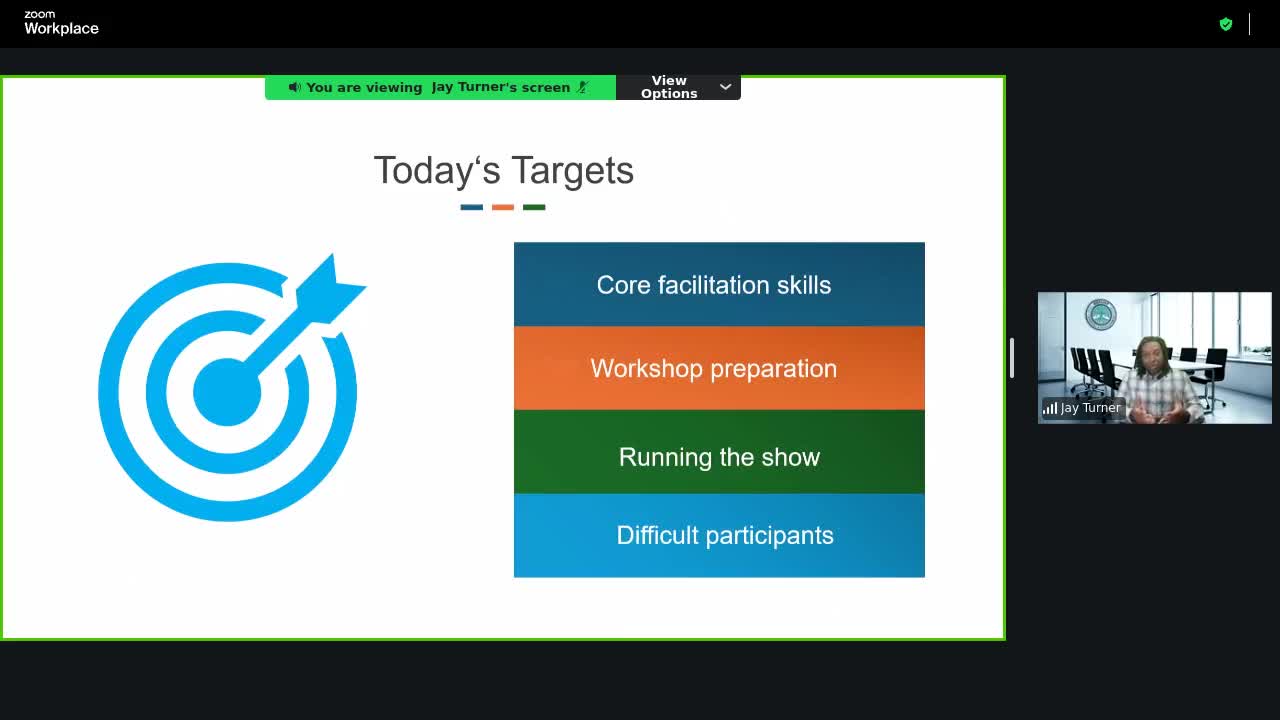
throughout our time today,we're going to focus on four
things, and that understandingsome of the core facilitation
skills, getting some tips onpreparing for your workshop or
your meeting. Then, you know,how do you effectively run the
show? And finally, how do youdeal with difficult
participants? So, for me, youcan expect a couple things.
First, there's a lot ofinformation, lots of
discussion, lots of exercises,and it's not uncommon that you
might feel a little bitrushed. That's kind of
intentional. I mean, my goaltoday to kind of give you
smorgasbord of approaches andthings for you touch, but
you'll also be able to go andfurther independently explore
those after the session. Andthen second, for everybody who
identified as a facilitator orchampion, I'm going to ask you
to engage with two mindsets.First, as a participant. And
then second, I want you tokind of think about like your
meta-brain and consider thehow and why of everything that
I'm personally doing as afacilitator throughout the
course. And so as you do thatfor my champions and
facilitators, you know, takenote for yourself and queue up
any of those questions thatyou might have. I do intend to
leave some time at the end forSo those are my expectations
for today. And I just want tothrow the floor open to you
really quickly. You know, whatdo you expect to get out of
this workshop? You can justdrop those responses in chat.
So when we talk aboutfacilitation, this is really
all about helping a group doefficient and meaningful work.
It's all about making sureeverybody in the room has
chance to be heard withoutfalling prey to group think.
And then also ensuring that wehave actionable outcomes. The
best facilitators that I'veworked with throughout my
career, they do a few thingsreally well. So they have a
knack for encouraging peopleto think and to articulate key
ideas. And they're also onpoint when it comes to asking
vital questions that are goingto help the group uncover
variables and identifyproductive actions. And then
finally, one of the bestthings that great facilitators
do, or more accurately, whatthey don't do solve the
challenge for the team.Ultimately, as you become more
proficient as a facilitator,you know, you're going to be
able to supercharge your groupperformance because you'll be
able to eliminate frictionthat comes with collaborating
with team. And then alsoyou'll be providing a process
for your team to follow, andyou're going to be leading
them through that step by stepto uncover insights and
solutions. So Iwant to hear from you, and
we're going to do a littlebreakout activity. So what I
want you to do, I'm going toput you all into randomly
assigned breakout rooms. I'mgoing to give you five
minutes. And during that fiveminutes while you're with your
breakout group, I want you todiscuss the skills that you
believe to be the mostimportant skills for a
facilitator. And now whiley'all were having that
discussion, I want you toreally hone in on what are the
top five skills that you thinka facilitator needs to have in
order to be successful whenthey're working with a group.
After you all have had your,after you all have come to
that consensus on your topfive, you need to pick who's
going to be the representativefrom your group, because we're
going to have thatrepresentative kind of present
your findings and drop them ona whiteboard so we see what
the wisdom of crowd holdshere. All right, so I'm gonna
pause for a second. Whatquestions do you have about
this activity? Do you have anyquestions? All right, y'all
ready to go? Okie dokie, itlooks like we have 30
participants. I am going toopen up for breakout now. We
will do six breakout roomsfive. So let me find my
breakout control. You will berandomly assigned, so I can't
pick who you're sitting nextto, but everybody please have
a good time. All right, I'mgoing to turn this on. I have
timer set that I'll getclicking once we get you in
there and I'll call you backin after five minutes. Also
keep track on your own so youcan share the conversation
stay on target. Here we go,breakout rooms and effects.
All right, all rooms are open.All right, looks like they are
all in their room. Allright, I need to take my
little slide out of, I don'thave a choice, it has to be in
the room.Okay. Oh, this is good to
know. Okay. So you and I, wedon't get pulled Okay. Because
we are the hosts, I think.Yeah. Yeah. Yeah. Very good
stuff. All right. So, um,yeah. Audio quality clear so
far, videos still clear.Looking at the groups. Those
are good groups.All right, so what we're going
to do is after we calleverybody back from these
little breakout rooms, youwill need to share a
whiteboard. Okay. Becausewe're going to have the
representative from each grouptype in their top five
facilitator skills.I can do that.
I think I'm going to go andjust drop in couple of these
rooms and see how theconversation is going. Okay.
I'm not going to do that. If Ido that, it's going stop my
screen share. I don't feellike trying to fix that. Oh,
broadcast. I'm not going tosend the message. You can. Oh,
great. Okay.I'll wait until we two minutes
left and I'll send thatmessage.
All right, I'll put thewhiteboard up.
I get all gonna close out theroom and give everybody back.
Got everybody starting to popback in from their breakout.
About another 30 seconds,everybody should be back in
here. It takes while for thesethings to switch over.
Okay,so
just a really quick reaction.You can share that in the chat
with me. How was that exerciseand how was using the Break
Room and Zoom particularly tohave that conversation? Just a
quick feedback and chat reallyfor me.
Small group was nice. Thankyou very much, Jamie. Uh,
yeah, so that was the breakoutrooms, but you know, the time
went by very quickly and, um,you know, that's one of the
things that, that, that wewill talk about is like, kind
how do you, how do you manage,how do you manage the time,
particularly, in, in an onlinesession? And we'll be getting
to that just a moment. Allright. Um, I see also Jamie
said they wanted share screenor have a whiteboard to do a
think and share exercise.Yeah, that's something that I
can look into. I haven't usedthe breakout functionality
much in Zoom, but I'll see ifthat's not something that can
go down, because you might beable to do that when you all
are facilitating these kindsof meetings. Okay, so what I
want you to do now, Jenniferhas shared a whiteboard and we
asked each group to designatea representative who would
come and they would put intheir top five items On the
whiteboard, you about what arethe top skills for successful
facilitators. I'm going tolabel this board here, top
five facilitation skills. Allright. And which group wants
to go first share their topfive?
Now I'm thinking, of course, Imean, are you all seeing
annotation tools on yourwhiteboard cascading down the
left-hand side? Yeah, I am.It's letting me click on them.
Okay, that's great. So youhave to sticky or something to
type. Yeah, you can just usesticky note and put all five
on there.Oh, I like this. Your
organizer is just great. I'mgoing to let the group do what
they do best. If I didn't wantto sticky, let's do sticky.
Alright, it's been decided.Okay, people coming in. All
right, it is a really goodresponse that is going to take
shape here. Well, we're notgoing to be able to make any
more heads or tails of it thanyou.
All right. Yeah. So, yeah, Imean, there's some see like
some recurring thought around,you know, staying on point,
staying on track. I mean,that's super important when it
comes to running thesefacilitated sessions. There's
only so much time that youhave. And then every time we
get together, it's taking timeaway from something else. So
you're right, maximizing thetime. You know, other ideas
here around, you know, makingsure that everyone has an
opportunity to collaborate andparticipate there by ensuring
that all ideas are beingheard. There are ideas here
that revolve around, you know,being diplomatic. And with
that, a lot of that goes into,you know, how well are we
listening to each other? Andas facilitator, always staying
neutral. And that's a very bigdistinction to make here. You
know, as a facilitator, youknow, the only dog you have in
the fight, and part of mysouthern colloquialism, I'm
from Georgia, but the only dogyou got the fight here It's
making sure that the groupgets to the outcomes and the
actions that are expected fromthe people who are sponsoring
and championing project. Sowhen it comes to your
individual thoughts around acertain part of the
conversation, those are reallysecondary. Your primary role
is to further the conversationand keep it pushing forward.
All right, we've got someother stickies here coming in
from side. You know, allthings that seeing in other
places, active listening, youknow, being flexible, and
showing some really goodleadership. If I can pull some
of these over into mainstream,the view, I'm moving some of
these around y'all. There wego. Thank you. Thanks. Okay,
so the wisdom of the crowd,Tasking to really zoom in on
what I think are the mostimportant things for being an
effective facilitator. Youwill see that I have my list
of top eight items for whatdoes it take to be an
effective facilitator. I'mgoing to bring those and let's
see how y'all did. All right,Jennifer, you can close the
whiteboard and we'll make surewe hand this to the group
after class and they can goback to this. I think you have
to share it again.You know, these are my top
eight and y'all pretty muchhit most of these. I'm not
going go over them. Not all indetail, just a few things real
quick. Facilitative mindset.What this means to me is that
your job to separate aconversation. I like to say
that as facilitator, we arethe guide on the side and not
the sage on the stage.Everyone mentioned time
management, set an agenda, doyour best stick to it. We're
going see some examples of,you know, how conversations
can get sidetracked and whatare some tips we're bringing
those back in. Another thingthat I want to mention here is
when you are, you know,facilitating, whether in
person or online, you have tokeep your energy high because
people are going to take theircues from you. So if you look
like you're sleepy and you'reacting like you're sleepy,
people are going to getsleepy. Other things that I
don't necessarily know if Ithought this would come up,
but, you know, cutting off foryour discussion, was just
making sure that when thingsare starting to go south or
we're circling the drain, soto speak, as facilitator, you
can recognize those momentsand then you can kind of get
the group unstuck and continuegoing forward. And then I
think out of this whole list,another thing that I will just
highlight for mine is givingclear instructions. Um, you
know, I hope that theinstructions that I've given
so far today have been clear.And what I, what I want you to
try to notice, what I, what Itry to do is I try to give the
instructions once, recap them,and then always ask, what
questions do you have? NoticeI'm not asking, do you have
any questions? That's a yesand no answer. Some people may
have questions, but if youask, do you have questions?
They might not feel invited toactually share those. So I'll
leave those with you here.see, I have to just organize
my layout here really quickly.Sorry about this, folks. I've
got to get my panels going upagain so I can see everybody.
All right.Okay, we're back. Okay. So.
Now that we have a more clearpicture what facilitation
entails and skills that youneed to really slay it while
you're doing I want to talkabout how you can set yourself
up for success before yoursession even begins. So let's
start off with just a fewbasic facilitator pointers to
make sure that you're readyfor game day. So first thing
I'm going to recommend is ifyou are relatively new to
facilitating, I would say getpartner or a co-facilitator
whenever it's feasible. You'regoing to find that some of the
conversations that you haveare going to be complex and
sometimes they'll be fairlylengthy. if you have a
co-pilot having a second setof eyes and ears there, it's
going to be really good foryou. Not only to lend another
voice to the conversation, butalso to help you manage your
physical and emotional energy.I mean, like facilitation
draining. I mean, it can bereally tiring because you're
having to be on the wholetime. And plus when you have
someone else with you, itallows you to be more present
inside of the conversation.The second thing is, and this
came up in conversation just amoment ago, and that plan your
discussion and activity timinggenerously. So for example,
let's say that you have 15minutes for a small group
brainstorming session, and youwant to talk about how your
particular branch is going tobetter connect with the senior
population. So the discussionitself might be 15 minutes.
But then if we're in person,you need to build in time for
people to break out of thegroup. Then you have to have
time for giving instructionsfor what you're looking for.
Then you have to leave timefor answering their questions.
And then you need to leavetime for debriefing the
conversation. So you see a 15minute conversation can easily
balloon into say 30 minuteswhen you think about all the
things that go into theconversation and then the
debrief. Third thing I wouldlike to point out is to really
prioritize psychologicalsafety. You know, people can't
be creative, people can't beopen if they're scared to be
judged. So for instance, youknow, some people might not be
comfortable candid when theirboss or the director in the
room. So your job as afacilitator is to kind of like
preempt some of these issues,you know, and ask, you know,
ask the people that you'reworking with, you know, are
there certain people that youthink could be a barrier to
our conversation? So that youcan win interference and make
sure that your team is able tohave the conversation that
needs to happen. Next, I'dlike to encourage folks to
model the behaviors that youwant to see. You know, for me
personally, I'll sometimesoffer like a bizarre idea or
half-informed response just sothat people can know that it's
okay. I'm an extrovert. I tendto think out loud on what, so
I mean, I'm even willing toGive response. I don't have a
full answer. I'll just say,hey, you know, I'm an
extrovert and I need to thinkthrough this out loud. And
then I'll start thinkingthrough, I want people to know
that that's okay. And thenfinally, you know, I encourage
everybody here to get seriousabout play. Sometimes it feels
like we're supposed to havetoo much fun at work. And you
know, for surgeons, that'strue, but for most of us, it's
BS. So, you know, bring yourpersonality, your wit, your
sense of humor, And just beauthentic self when time to
facilitate because the lastthing that people need is to
see you being uncomfortable.And the only way you can be
totally comfortable is if youyourself. And then also when
it's appropriate, I want youto look for activity,
especially energizers for whenthe energy in the room seems
kind of low. And that canhappen between very lengthy
discussions. It can happenafter lunch. So you want to
have some things in your backpocket to perk people and to
re-engage them. You know, I'mall about laughter, joy, and
goofiness. That's how I livemy life. I'm still 16 at
heart. Now, when we talk aboutfacilitation, there's also
this other piece and I want togive some tips specifically
for remote facilitation. Youknow, the ones I just gave are
pretty germane to in-person orremote facilitation. These are
specifically for, hey, ifyou're leading a meeting
online, here's some things youcan do. All right, first keep
that energy right? I mean, notonly should you aim to make
your sessions a little shorterthan what they would be in
person, because we all havelimited attention spans, like
up staring at a computerscreen, but you also got to
bring the energy like way, wayAnd also you have to think
about too, unless you haveprofessional gear, most
microphones can strip yourvoice like it's natural
nuance. So you want to dothings like vary your pitch,
vary your pace so that you cankeep your voice interesting
for the people who are on theother line. And then also when
it comes to energy, don'tforget your icebreakers
because we want to get peoplein the mindset at the very top
of a meeting that they'regoing to be interacting. So
make sure that you do those,even if you're online. Second,
you know, I'd like toencourage folks to adapt their
communication. Slow down alittle bit. And again, make
sure you allow more time fordiscussions to unravel than
you would in person. Now, whyis that? You might be
thinking, well, here's why.It's because when you're
online, it often takes peoplemore time to feel comfortable
sharing their thoughts. Andthis is mainly due to the
passive way that we kind ofgotten used to like using
online stuff. I mean, rememberwhen webinars first started,
we were just used to sittingthere and having a talking
head talk to But when we'reinside of these facilitated
conversations, we needeveryone to participate. And
then third, you know, shareonly what's needed, when it's
needed. You may find yourselffacilitating an online meeting
and you're discussing multipleitems. And that means you
might need people to usemultiple online tools, like a
whiteboard or video clips tosupport your conversation. So
if you're doing all that, onlyuse the tools you need in the
moment and please Please,please, my people, try to keep
the participants from havingto jump in and out between
different applications. Imean, that ish gets confusing.
It confuses me and I do thisworld living. All right, and
then, you know, I think thisis self-evident, but it goes
without saying, you have tohave a plan B for technical
difficulties. It is not a dayin technology until something
goes wrong, so I need you toalways be thinking ahead about
What's your backup plan incase the worst case scenario
happens? Like, for instance, Ilive in rural Northeast
Tennessee. storm can comethrough here and knock out my
internet. It can startraining. You know what I'm
saying, duck? I start blinkingback from tears and my
internet goes down. So like,what do I do? I mean, you'll
see in front of me, I've gotmy cell phone right here on
deck that's out there as ahotspot. I have another cell
phone that has dual screensthat I can open up like a
little laptop and I canpresent from this other cell
phone. Always have a fail safebecause your technology is
going to get you one day, butalways be prepared. You don't
have to get ready if you stayready. And then I do want to
call out this last thing iskeeping it simple. You know,
when it goes to any kind offacilitation approach,
sometimes simpler is betterbecause we just need to stay
focused on the results.All right. I'm going just talk
about this really quickly. Sothis is all about kind of
going back to in-personfacilitation. The way that you
set your space can do a lot tohelp or hinder you in the
outcomes that you're trying toachieve. Now, you know, by a
quick show of hands, butthere's a reaction panel
inside of your, inside of yourZoom bars here. I mean, just
give me like a thumbs up ifyou've seen, I would say at
least half of these layouts inreal life before. There we go.
Yep. I'm seeing in chat. Yep.Yep. I'm seeing a thumbs up.
I'm seeing some hands up.Yeah. I mean, so we've all
seen these things. When youare facilitating larger group
conversations, and I imaginethat some of the facilitators
here, y'all might end uphaving, you know, you might
have, you might end up leadinga conversation that's more
than six people, you know, youmight end up leading ones like
today, you might have 20people. You gotta be prepared
with the room. So I just wanttalk through these really
quick. Team tables. I lovethese. I use these a lot in
kind whether I'm doing aworkshop, Team tables are a
go-to for me. They are greatfor building good rapport
amongst participants. Theyalso have an informal vibe to
They also give people enoughroom to move around and still
be comfortable. Now thedownside to your team tables
is depending on the size ofthe room and the way you
arrange the tables, you canHinder some of the sight lines
of other people. So you also,so you always have to be
careful about how you arrangethese tables so that, you
know, like one table is notblocking the view of the next
table. Well, we bounce off tothe right and we look at that
banquet style set These arereally great for, for the
potential for interaction,because at a banquet style
table, you notice they'recircular everybody's facing
each other. There's no firstamongst equals. I mean, that's
the table of parity, if youwill. And also when you use
banquet salad tables, becausethey are circular and because
you can fit them tighter, youcan maximize the space in a
larger room. Now, the downsideto that is that even though
banquet salad tables promotekind of like familiarity with
the people who are sitting atthe table, it can also
encourage clicks becausepeople are just kind of with
their group and they havetheir back to everybody Now
y'all all have seen theclassroom set up. This is very
typical, great for takingnotes. If you're going to have
a session where you're goingto asking people to do like a
lot of writing, maybe evenworking on like really large
flip chart paths, you mightwant to have some classroom
style tables there so thatpeople can maximize their
writing space. But of course,you know, a con for these
classroom style set up is veryformal and you can have very
limited line of sight. And itmakes it challenging for
people to get between thetables to interact with each
other. Boardrooms are reallygood for if you want to have
direct interaction betweenyour participants in any
direction. You see at aboardroom table, everybody has
the ability to face eachother. And a good part about a
boardroom too is that they'reoftentimes wired for, you
know, connectivity. You know,this is great if you're
leading a session where youwant person to have their
laptop and to actively useGreat setup for that. Now, of
course, the downside of aboardroom is that, you know,
the people at the end of, thefar end of the table, they
might feel isolated. It canalso lead to some weird
perceptions power dynamics,particularly if one of people
who's a part of the grouphappens to be the boss, right?
I mean, putting them at thehead of the table just even
reinforces the boss statuseven more, even though we want
everyone to be kind of likepar when we have these
conversations. Specialists arejust kind of like a nice
hybrid between team table anda banquet.
If you have them facing towardthe front of the room that put
all lines on the facilitator,they're really good for brief
group work because you canhave a little bit more elbow
room between people. And thenalso, since you are not having
a couple of chairs towards thefront end of the table, you
get better sight lines to thefront of the room. And of
course, the downside of yourcrescent setup is that It's
not nearly as compact as likebanquet-style seating. And
then also it can lead to someirrelevant chatter between
tables because it's real easyfor one person the crescent to
lean back to somebody behindand be like, Hey man, did you
see that? That was whack, youknow? So, so that kind of
table can lead to And thenfinally you can get to use
tables here. This makes itwhere this is more geared
toward presentation. Andthat's kind of outside the
scope of what we're talkingabout, but I want you to be
aware of Uh, you know, forwhatever reason, if you as a
facilitator need to be centerstage, um, and you need to be
the focus, uh, you is reallygood. So I might encourage
this form of feeding if, uh,ultimately, you know, your
group, uh, gets to a pointwhere you have recommendations
to make or report to give, youmight actually deliver your
report in a view withfacilitator or the group lead
at the head and sharing theinformation with the people
sitting around those tables. Iknow that that is a lot to
take in about room layout. Ipromise you all that I'm going
to give you a copy of thispresentation after our
session, along with the noteson how do you lay out a room.
All right. I want to do just aquick pulse check with
everybody right now. Use thatreaction panel and just kind
of, kind of give me, you know,like, how are you feeling
right now? I mean, you cangive me like a happy face if
you're feeling that the pacingis good and that you're
learning something. Give me afrown if I need to slow down.
You can drop stuff inside achat just to make sure that
we're adjusting because we gotabout to get to the stuff. Allright. Hey, y'all making me
feel good over here. Allright. Let me get some thumbs
up. Y'all bring it Okay. Allright. Thank you. Thank you.
Okay. So let's talk about thebig part here. This is the
meat and potatoes, likerunning the show. So now that
you set yourself up forsuccess and you've been
thinking ahead about yoursession, we got to get into
that dirty, dirty, into thenitty gritty, you know, from
the dirty self and, you know,juices up, A's down. So let's
talk about what goes on whenyou run the show. I believe
that when it comes tofacilitating meaningful
conversations, you're doingfive things. You are priming
people to get into thatthought process of engaging in
a conversation and being ableto make a creative leap. And
then from there, you are kindof framing, you know, here's
what the challenge is today.You're kind of giving context
around And then when westarted getting into step
three, that's where you startexploring the conversation.
You're looking for insights.You're trying to dig deeper
into you know, some of thechallenges or the problems
that we're investigating. Andas conversation unfolds,
you'll find that you've got toget a lot of things to come up
in that surface that you asfacilitator, you're going to
want to help your team refinesome of those thoughts.
Because, you know, because notevery idea is a great idea, or
we so many things that areproduced as artifacts from
these conversations that weneed streamline them that we
can do the very last thing.That's kind of like review
where we are and get someconcrete action and determine
like, you know, where do we goSo I want to walk through this
and give you not only pointersaround how to do each piece,
but also some practicalexamples that you can use. I
will also preface this partour presentation by saying
that since we're not inperson, We don't have an
opportunity to really see someof this stuff play but you
know what, you know, me beingthe guy I am because I'm so
nice and I'm your guy. I wentout online and I found like,
you know, a few video clipsthat have like examples people
doing some of these things sothat you can see them in
action. So I will just giveyou the heads up. We four
short videos that I'veinterspersed in here and we'll
kind of talk around All So.First up priming. And when we
do priming in terms offacilitation, this is all
about getting the mind and thebody to make creative So I
recommend that if you want toprime people for a
conversation, you do a fewthings. You send the agenda in
advance. You know, this isgoing to allow your
participants to not bepreoccupied and, you know,
potentially worried about thecontent of the meeting.
Sending the agenda not onlygives the flow of the day, but
it also gives folks a sneakpeek what y'all are going to
be doing. And thenadditionally, depending on the
complexity and the depth ofyour session, it may make
sense to say pre-work inadvance so that you can
maximize the time that youhave in your meeting. Now,
this one, number two, isreally important. I'm all
about the icebreakers, and Iwould like to say don't just
choose any icebreaker. Pick anicebreaker fits your topic.
Because, you know, icebreakersare great and you can find so
many of these online andthat's great, you know, but
the majority of them are meantto be generic and just to get
people and moving and talkingand it's fun, right? But I
want you to take theicebreaker to the next level
and tie it directly to themeeting topic. You know, you
saw how we did it today,right? I mean, we got people
talking and the icebreaker wasspecifically about the topic
of this session. And I'm goingto challenge you to do the
same thing when you do youricebreaker. And then finally,
when it comes to priming, Iwant you to also try to take
some time to discover whatyour participants' desired
outcomes are. And this isbecause facilitation is a
dialogue. And as the personrunning the show, you should
have a really clear idea ofyou want the meeting to
accomplish. But here's thething, your participants might
have ideas as well. And so howcan you find out what your
participants are expectingfrom a meeting? How do you
find You just ask And thenalso you might want to ask
them questions such as, whatdoes success look like for our
meeting? I mean, get thesuccess criteria and then, you
know, how will we know ifwe've accomplished what we
needed to today?I'm just curious. And this is
chat, quick chat, share ourbrainstorm here. What are some
of the most effectiveicebreakers that you've seen?
Has anyone seen like a reallycool icebreaker? You can drop
in chat, or if anyone'sfeeling very adventurous, they
got one they just really wantto share, you can come off
mute and share it with theclass.
All right, well it looks likepeople are mulling things over
and that is a-okay. Here'swhat I want to do. So I'm
showing you, I'm showing you acard from this thing that I
love. It's a tool calledpipdecks, P-I-P-D-E-C-K-S,
pipdecks. And they give youlots of things that can help
you with your workshops, youricebreakers, your activities.
But I pulled one of thesepipdecks that I personally
love. And for an icebreaker,and I love it because it's
adaptable. So with thisicebreaker, you know, the name
of the icebreaker, and you canread what's the screen here.
It's a, you know, it's allyour job. And essentially the
idea is where you give peoplethree minutes and you have
them draw, um, you know, likewhat, what does their
day-to-day job look And you'llbe surprised at some of the
things you Now that's all welland good. That's cool. But
this is easily adaptable foralmost any topic. You can say
something like, you know, drawhow you envision your job is
going to be in the future as aresult of a change you were
making. Right. If that's like,you know, if you're doing a
workshop on like change, youcan just, you can switch the
drawing activity to that. Oryou could say, you know, draw
my role on this project team.Get people more on the mindset
of thinking about, well, thisis what I'm doing for this
particular working group. Youknow, so, so there's lots of
different ways that you canpick something as simple as
this and just, Tweak it just alittle bit to make it tied
directly to your topic athand. Again, you will get a
copy of presentation, and ifyou want this step-by-step
exercise, it'll be here for Soafter we have primed our
people, one the key thingsthat we have to do is to frame
the challenge effectively. Andwhen we talk about framing,
this is all about settingclear objectives, helping
people see why theconversation important, And
it's creating a structuredenvironment where we can
really get people to becreative. And so this concept
of framing crucial for guidingthe group toward what I
consider productive andinnovative outcomes. So when
we talk about defining theproblem clearly, there's a few
things that we want to bespecific, and that is we want
to make sure that the problemis clearly articulated and
we're not using vague languageabroad statements. We also
want to provide somebackground information that's
going to help our participantsunderstand, here's why this
conversation is important, andhere are some of the
implications that this mighthave for And then finally, you
know, when it comes todefining your problem or
defining the session clearly,have clear objective, have
actionable goals, and makesure that you're always
thinking about, what is itthat I want to accomplish by
the end of this session? Andthen we talk about relevance,
and that's explaining Reallywhy this is important and
finding a way to connect tothe interests of the people
who are in the room with youand also to the broader
organizational context. Andthen finally, you know, talk
about the impact, right? Ifthis goes well, if we do what
we're supposed to do, how isthis impact going to
successfully make us evenbetter as an organization? So
many great opportunities forthat. And then finally here,
setting clear parameters. Ithink this huge. It's
important as facilitator thatwe define what's in scope for
our discussion and what's not.And then also, if you happen
to know what the resourceconstraints are for whatever
project or initiative you'reworking whether that's
resources around people,around time, around budget,
establish those frames upfront because we need to have
guardrails for theconversation. So here's
another one of my go-toactivities for, you know, how
do establish constraints?Again, I mean, this is just,
you know, from some PIP decks,you know, I use these, I keep
them in my back pocket in a Sowith this one, you're
literally just asking peopleto sit down and five minutes
to brainstorm what do theythink the constraints will be
for a given, I mean, for likethe given conversation. And
you let everybody silentlybrainstorm for five minutes
about constraints, and thenbring the group together and
have them pool theirconstraints, you know, and
obviously there might be someduplicates, some of the
duplicates. But you would getlike a really nice and
interesting list around like,what are some of the strengths
that people might see for theconversation? And so, you
know, for example, I'm workingwith a client, they are
revamping their performancemanagement process. We did
this, you know, building afence around the playground,
so to speak, activity. Andsome of constraints that we
got were, you know, and again,it's around performance
management. So constraintswere early in the process, so
dare to dream big. Basically,like nothing's off the table
right now because we're soearly Another constraint that
we came up with was, you know,this was our initial focus was
mainly on the performancereview timeline. So for this
conversation today, we're onlygoing to talk about the
timeline. We're not going tojump down the rabbit hole
trying to fix the performancereview form, because right now
just care about the timeline.Use the sense method to get
some of those really goodconstraints so that you can
keep your conversation onpoint while also keeping your
audience bought Now,once you've properly framed
the conversation by clearlydefining your topic, you've
established it's relevant,you've set some clear
parameters, the real work isto start. And so exploring is
all about, you know,leveraging your good
facilitation techniques to getthe maximum amount of
participation from everybody.And then also asking the right
questions to spur conversationso that you can delve deeper
and to get some insights thatmatter. And as you explore,
the important question isyou'll also find yourself
capturing these insights fromthe wisdom of the crowd. And
you've got to be doing a lotof capturing on like, you
know, post-it notes and flipcharts and whiteboards. And
then again, since we're not inperson, I can't show you this.
You know, like I would love tohave done if we were together,
we'd actually role play and dosome exercises, but lot of
good friends at the Universityof Massachusetts have like
some really good videos that Ifree for our sessions. I'm
going to play this video righthere around maximizing
participation. All right. Ithink I have everything set up
where you should be able tohear the audio and see the
video in real time. You know,ping me in chat if we have
issues.The best team meetings include
the voices of eachparticipant, but not everyone
comes to the table with thesame comfort level in using
his or her voice. Watch howthe facilitator demonstrates
three different techniques toencourage and value
participation from each teammember.
A round-robin process is wheneach person is invited to
respond to a specificquestion. The key to this
process is each person has anopportunity to express their
opinion without interruption.No one else responds to
disagree or even to agree. Youcan make the round robin
efficient by setting a timelimit for each person. This
technique is useful when it'simportant to know where
everyone stands. We've beenworking hard on our proposal
to solve some key safetyconcerns. It's important that
we understand how each of usfeels about this proposal
before we move it up to thenext level. So our round-robin
prompt is, in a few words, howsatisfied are you with this
current proposal? We'll hearfrom each person before we
address any issue raised. Ithink it's ready to move
forward. Okay. I think it'smostly strong, but I have some
concerns about And I have aminor concern with one piece
of Okay, so let's hear theconcerns and talk through each
Some people contribute theirbest work when they have time
to think individually about aproblem first. You can get the
best from your team by givingthem time to reflect before
opening up a group discussion.Today we're going to talk
about safety, health, andwell-being in this
organization. To start we'regoing to take five minutes and
jot down our thoughts on thefollowing two questions. What
contributes to safety andwell-being while we're at
work? And what stands in theway of safety and well-being
while at work? List yourthoughts to this question on
your piece of paper and thenwe'll have a general
discussion about these safetyissues based upon what we've
written and I'll keep track ofthe time so you can think and
write and I'll give you a oneminute warning before the five
minutesMany people find it easier to
talk to one person than totalk to a larger group. This
is especially true when teammembers are still getting to
know each other. Talking inpairs can build team members'
confidence to contribute andcan raise the quality of the
discussion. The process you'reabout to see is called
pair-share. This is especiallyuseful when you have a large
number of participants and youwant everyone to contribute.
Today we'll talk about safety,health, and well-being in this
organization. So to start usoff, let's take a look at
these two questions. Whatcontributes to safety and
well-being while at work, andwhat stands in the way of
safety and well-being at Turnto your neighbor and present
your thoughts to each other.Next, choose three thoughts
that we'll talk about as afull group. I'll meet with
Abby. In thisvideo, you saw the facilitator
use three differentparticipation techniques.
Round robin, personalreflection time before a group
brainstorm, and pair share.All So I'm curious, I mean,
because I'm sure all of ushave sat facilitated
conversations before, whetherit's a work meeting or
strategic planning sessions,or even a workshop, like maybe
one that I brought down toFlorida, because I see some
familiar faces When it comesto facilitator getting you to
participate, you know, likewhat, what tends to work best
for you? And I'll start thisone off. So I'll say that, You
know, I mean, I might appearvery gregarious on paper, but
you know, sometimes when I'min a room and it's all full of
new people, I can be a littleintimidating. So I mean, I
like a pair share. I mean, sopair shares are one that I
like a I see Jamie saying,thank them, right? So get a
little bit of self-reflectiontime and then able to share
out to a group. What's someother thoughts? What, what are
some these things that workbest for you to get you
engaged? Allright, Lisa is another fan of
the pair there. All right,Cali, the round robin. Yeah, I
really love the round robin asa way for, you know, making
sure that everyone has anopportunity to participate and
also a sexy expectation thateveryone should participate.
All right. It looks like roundrobin is probably our popular
one at the moment by alandslide, round robin by a
landslide and then think andshare coming in second. I want
to talk a little bit moreabout exploring, and that when
you use skills like, you know,your round robin, reflect
them, brainstorm, and thenpair share, you got to get
your participants ready tofully engage for the duration
of the conversation. But ofcourse, it takes a certain
degree of mastery about askingthe right questions so that
you can separate a dialoguethat's going to be meaningful
and impactful. So I'm going toshow another quick video here
about three questioningtechniques that you can use to
make sure that you're drivingthings forward.
As a facilitator, how you askquestions can have a powerful
impact on how your teamresponds. You want to ask the
right kind of question basedon what you're trying to
accomplish. Watch how thefacilitator uses open-ended
questions Opt-out questionsand opt-in questions to
accomplish different types ofgoals. A yes-no
or closed-ended question canget you a fast answer, but it
doesn't generate creativethinking or help you
understand a situation moredeeply. Instead, use an
open-ended question when youwant to learn more about a
topic or when you want tounderstand how people view a
situation. An open-endedquestion helps team members
think in new ways about aproblem. We start an
open-ended question withphrases like, what do you
think about, how might we, whydo we think, or can you say
more about that? What do youthink about the idea that Abby
just proposed? So like part ofit, but I don't think it goes
far enough because we won'tget good results if only some
people choose to participate.I think we need a more
comprehensive solution. A veryuseful question form is called
an opt-out question. Use thisquestion if you're trying to
see if anyone strongly objectsto something. You can use an
opt-out question for manysituations. For instance, you
can use it to make sure theteam is ready to keep moving
or to see if someone disagreeswith the course of action.
Here are two examples. Isanyone not ready to move on to
the next topic? I have onemore suggestion. I actually
think that Abby would be thebest person to take on that
task. Does anyone object toAbby taking on this task? I
think Abby would be great. Thelast question we'll
demonstrate is the opt-inquestion. This is where you
ask for people to affirm theiragreement to a decision. It
requires that people reallythink about their level of
commitment. Use an opt-inquestion for times when we
need all team members tosupport a decision or course
of action. Today we've madeexcellent progress designing
solutions for the problem ofcoffee burns on the job.
You've produced threeintervention options to
present to management, but nowwe need to make a decision
before we can move forward.Let's do a round-robin to hear
from each of you. How willingare you to propose these three
interventions as they arewritten to the Steering
Committee? Or does somethinghave to be changed before you
can support this proposal? I'msatisfied with all three
options. I'm fine withintervention one and two, but
I really think interventionthree would not be worthwhile
unless we add training to Iagree with Betty. Without
training, Intervention 3 wouldbe meaningless. Okay, Betty
and Carlos, it sounds liketraining needs to be part this
proposal. So, Abby, are youwilling to add a training
component to Intervention 3?Yeah, I think we need to take
another look at that. Perhapswe could do it next time? In
this video, you learned aboutopen-ended questions, opt-out
questions, and opt-inquestions. Try practicing
these techniques the next timeyou're working with a group.
Choosing the right questionfor the right purpose can have
a powerful impact on yourteam's decision making. All
right, so just again, usingchat, what are some your key
takeaways from using thesethree types of powerful
questions? Feel to share thosein chat while I get us queued
for our piece of content.As a facilitator, how you
ask... Sorry about that. Iended up running the same
video twice. All right. Butyes, feel free to share your
key takeaways. So, as you'rethinking about that, I want to
kind of bring in somethinghere. And that as we are
encouraging people toparticipate by doing stuff
like asking the right kinds ofquestions, really important
that we go beyond just talkingand move toward capturing
these key concepts they comeSo two really easy ways, and I
think these will get you a lotof mileage when you're
relatively to facilitating. Sotwo easy ways to do some good
captures is brainstorming andmind That's a great way to
really start getting someideas down on paper and having
some of the artifacts thatyou'll produce from these
conversations. So when wethink about brainstorming,
it's not about a meeting or asession, What are some of the
materials that you need tohave? Like we just need to
think about like materialwise, we're going to do a
brainstorm or a mind mappingsession. Like what's some the
stuff that you need to have inthe We're going to drop those
in chat. And definitely thankyou all for, um, you know,
the, your insights here. Um,yeah, see Kim. Yes. The opt in
opt out were new ones for WhenI first looked into this, I
was like, yeah, this is great.It was a really good way of
putting something that alreadykind of new by having the
terminology. All there we go,Jamie's on whiteboards,
papers, sticky markers. Yeah,I mean, beyond just for by
brainstorming. Yeah. I mean,like this is stuff that should
always be inside of yourfacilitator's toolbox. I think
Jennifer's with me enough andshe knows that when I come
down and, you know, peopleasking like, what materials do
you need? Even if I don't knowwhat my workshop is going to
be, I'll just be like, oh,give me the usual, man, you
know, give me some flip chartsand give me some broad tip
markers, some ink pens, a reamof paper, some note cards,
some post-it I mean, these areall things that you just need
to kind of have in your backpocket so that you'll have a
range tools that you can dothese exercises. Now, when
we're doing a brainstorm, youknow, it's really easy to just
get people to move togetherinto the small group. And you
give them the topic ofconversation and then just
give them time, you know, to,to really unload what some of
their thoughts I typicallyfind that with brainstorming,
I encourage people to put onethought per sticky because
oftentimes you'll want to growyour, you want to, you want to
transition your brainstormfrom just a random brainstorm
into something that's morethemed and clustered. We'll
talk about that momentarily. Icall those affinity But
brainstorm and just give themtime and make sure that people
stay on task and on topic. Thebest way to do this, if you're
doing small groups, and ifyou've been one of my
workshops before, you'llnotice that, you know, just,
just walk around the room and,you know, be present. Also,
you know, be a fly on the walland listen to some of the
conversations and, you know,and see if people are still
brainstorming and being on,being, being like a fully
engaged on top of there.Another thing that you can do
for capturing faults whileexploring ideas is mind
mapping. I'm relatively surethat most people here have
heard of mind maps, but thisis a great tool use,
particularly in small groups,where you'll have people
discuss a topic. What I likeabout mind mapping is if you
have multiple topics and youhave multiple small groups,
you can assign one topic toeach group and you can cover a
whole lot of ground that Whenit comes to a mind map, as you
know, I mean, you put the mainconcept as like a node, I call
that the parent. In this case,this is a mind map of like
progressive discipline. So youput the parent node at the top
or in the center of yourpaper, and then items that are
related to that main topic,those are your subcategories.
I call them children, youknow, I mean, because like in
real life on the parent, I gotlike 50 million children, you
same thing with a mind Andthen if you have a subcategory
to your category, then I callthose grandkids. So for
instance, if you're looking atthis mind map here, when we
get to the child item of thesteps around progressive
discipline, you'll notice thatthere are four individual
things that you think aboutfor grandkids that you got to
see, so to speak, that's yourverbal warning, written
warning, et cetera. So a mindmap, again, just a really easy
way to add more structure tosomething that would be a
brainstorm. All right. Now Iwant to move on to like, what
can we do to refine our ideas?So, you know, we capture a lot
of things with a brainstormand with a mind map. It's
important that we make thetime to make sense out of all
that stuff that we'regenerating, or in other words,
to refine And so a couple oftechniques of doing that, I
think that these will give youlike a lot of mileage here,
and that is affinity mapping.If you start off with a
brainstorm, and again,remember I encourage people to
put one idea post-it you'llsee, and I know this is really
tiny, but will see that youcan start grouping individual
post-it notes into categories.And so you do this by really
encouraging your participantsTo look at all the stickies
that they've made theirbrainstorm. And for them to
start thinking aboutthematically, how do they fit?
And you let the individuals dothis violently. And then they
go up to the whiteboard theyput their stickies on a
whiteboard in the categoriesthat they have been And then
other people will start doingAnd then once have all the
stickies on the board,together as a team, you can
look for overarchingcategories. Name them and
you'll find that you're goingto have like a whole lot of
stuff that tend to have anaffinity toward each other or
make these really greatcategories. And so this is a
really good way to startmaking sense of a lot of the
things that may appear randomin a conversation when we
first get started. And thenfinally, while you're all
together and you're looking atthe things that have come and
materialized, It gives anopportunity to have a
conversation, an even morerefined conversation around
some of the emergent themesthat came out of your
brainstorm when we put theminto an affinity Now, of
course, when you are wantingto get more so toward action,
you can take the items on youraffinity map, if I say that
three times fast, And reallyget people to vote for the
ideas that they think are thebest or the ones that they
want explore even more. Andyou can do this by having
people vote with points. Sotypically when I do voting of
this nature, would give peoplesay five And what I'll say is
I want you all to look all theitems on our affinity and you
have five And I don't care howyou send your five points, you
got five. And so what you'llfind is that some people might
put one point on fivedifferent because they were
like, Hey, this is, this is agood response. I'm going to
give five items one for atotal of five points, right?
Then the next person mightreally like two And so they
might put, um, you two voteson two different items, a
total of four points. And thenthey have one point left,
they'll put in a third. Or youmight have that person who's
like really gung-ho about thisone particular thing that came
up in the conversation andthey might put all five of
their votes in that one As afacilitator, your job is,
after all of that voting hasbeen done, is to go through
and look at each item andtally up the votes to see like
which ones have emerged thetop items. And then you have
to figure out like, what doyou want to do with like these
refined responses? Like, whatdo we want to do for like the
best ideas that came up orlike the, or the items that
people say, Hey, you know,these are the biggest
challenges that we face. Youhave to determine, well, like,
what's your what Do we need tohave a further conversation
around these items? Do we needto have another meeting about
these items? Is this somethingthat we can take these items
and then actually do some realaction toward them? As
facilitator and as a group,you all need to come to a
consensus around what's goingto be the next step for what
you identify for your votingprocess. And again, when we
talk about refining thesethings, this is just one
simple way that you can refineyour thoughts. There are tons
of methods out there and I'llbe happy to help you find some
additional resources. Now,finally, I know that some of
us there, we would love tolearn how to deal with
challenging situations thatcome up during facilitation.
what I want to do is just giveyou an opportunity to see,
well, I mean, how can we bestdeal with A key
part of your role asfacilitator is to manage the
meeting so that everyone feelswelcome and safe in
participating. On occasion,you may find yourself in some
tricky situations where teammembers breach the ground
rules they set for themselves.In this video, we'll
demonstrate how you canintervene to remedy three
common situations. Thescenario is a team of coffee
shop workers who are designingsolutions to the problem of
getting burned while servingcoffee. Behaviors such as
interrupting, monopolizing,and contradicting can get in
the way of people sharingideas and learning from each
other. Watch how thefacilitator acts quickly to
navigate these uncomfortablemoments to restore order and
keep things moving forward.I have an idea for preventing
coffee burns. How about weredesign the coffee stations
so that there's less chance ofthem bumping into each other?
I have a similar idea withthinking the same thing. Hang
on a second, Carlos. Let'sgive Abby a chance to finish
her thoughts. We have a groundrule that we get everybody a
chance to talk withoutinterruption. Sorry, my No
problem. All right, Abby, whydon't you continue?
Here are my thoughts on how wecan cut down on coffee burns.
I think first we need to getbetter quality cups and lids
because if you squeeze thisthe top comes right We also
need to improve trainingbecause baristas are checking
to make sure the lids are Wealso need to redesign the
layout because people arebumping into each other during
rushes. And last week I gotburned and I could not find
the first aid kit. Hang onBetty, I'm just going to pause
you right there. I can tellyou have a lot of ideas about
solutions to this realproblem. But the prompt on our
agenda is for each person tojust share two ideas before we
start to discuss. And I'vewritten down your suggestions.
So are you okay with us givingAbby and Carlos a chance?
Okay, who wants toI have an idea on how we can
cut down on coffee burns whenwe're serving coffee. One of
the root causes is that spillshappen when we're rushing
about. What if we just boughtnew coffee dispensers so we
wouldn't have to handle thesame pots all the time? The
company is never going tospend that kind of money on
new machines. I think it'smore important turn down the
temperature on the existingmachines and invest in better
quality cups and lids. So Iwant to pause you guys for
just a second. I just want usto remember that at point
we're just exploring ouroptions. We're not evaluating
or making any decisions rightnow, so it's actually okay to
have different perspectives onhow to solve this problem.
We're going to get a chance atour next meeting to evaluate
each solution based upon thecriteria that we set. So just
so we're clear on what Betty'soffering, you're suggesting we
work with the existingdispensers and get better
lives, I'm sorry Abby. Okay,Carla, what are your
suggestions? In this video,you saw the facilitator pause
when there was a breach in theground rules. She reminded the
group about the rules and theprocess before continuing with
the discussion. This way,everyone's clear about
expectations. As afacilitator, you play an
important role in minimizingdisruptive behaviors so the
team can accomplish its goals.I'm curious, after seeing how
this facilitator handled threerelatively common situations
that you might deal with whenyou're running a meeting or
facilitating a family session,I'm curious, where do most you
struggle? And what's one ofthe best things that you took
from this for how you mightcombat your struggle
Extra points if someone'sfeeling brave wants to come
off the microphone thismorning. Thank you.
I really like that the samplefacilitator referred to the
ground rules so it seems likethat's one of those
preparatory steps that need tobe included is establishing
confirmed set of ground rulesfor not interrupting that if
we're going to present ideaslet's go for one to two that
way everyone has a chance toshare that kind of Absolutely,
ground rules, mean they'reindispensable when it comes to
one of these sessions and theyshould be all mutually agreed
upon depending on how seriousthe conversation is you might
even might want to have peopleeven sign off them. Kim has a
lead in with the comment herethe facilitator jumped in
quickly and didn't take up alot of time to correct the
issue. Absolutely. When yousee things going off the
rails, the best thing you cando pause, acknowledge, and
then redirect. I love Anyoneelse want to share a struggle
area for them and maybetakeaway that they can put
back into practice almostimmediately?
All right, so I know that weare approaching the top of our
hour. And like I said, I didwant to make sure that we had
a few minutes left for Q&A. SoI mainly just want to make
myself available to you all,primarily my facilitators and
champions. What questionsmight you have of me? And how
might I be able to assist youin becoming an even more
awesome facilitator?All right, so I mean, what
I'll do then, I'll end withlast little chat box exercise.
So on a scale of and relief,when it comes to facilitation,
now that you sat through andparticipated very actively
this hour and a half thatwe've had together, I know
that you have to be afacilitator. Are you feeling
more grief or more reliefaround your facilitator's
role? Go ahead and drop thatAll right. Well, my friends,
it has been great morning formyself and I hope for you
well.As always, it's a pleasure to
be here and to share with youjust get to be a part of some
of the awful things that y'allbeen doing down at LHR. mean,
it's the world to I hope thaty'all have a great day. And I
know that this will not be thelast time that we talk. But
you know, in the interim, ifyou need me or anything from
me, here's my information onthe screen here. I'm jay at
edujay.com. You can alwaysshoot me an email and I'd be
happy respond to And with thatsaid, folks, have a lovely and
blessed and takeAll right. Thanks, Jay. I will
make sure that I get therecording of this over to you
and also a copy of the slideAwesome. Thank you. Have a
great one, Jay.
 01:28:07
 01:29:00
 01:41:38
 Jay Turner